
Advanced AI is generally expected to have some very high variance outcomes—it might herald everything good, it might destroy humanity. For instance, here are 800 random AI researchers’ expectations about how good the future is, lined up:
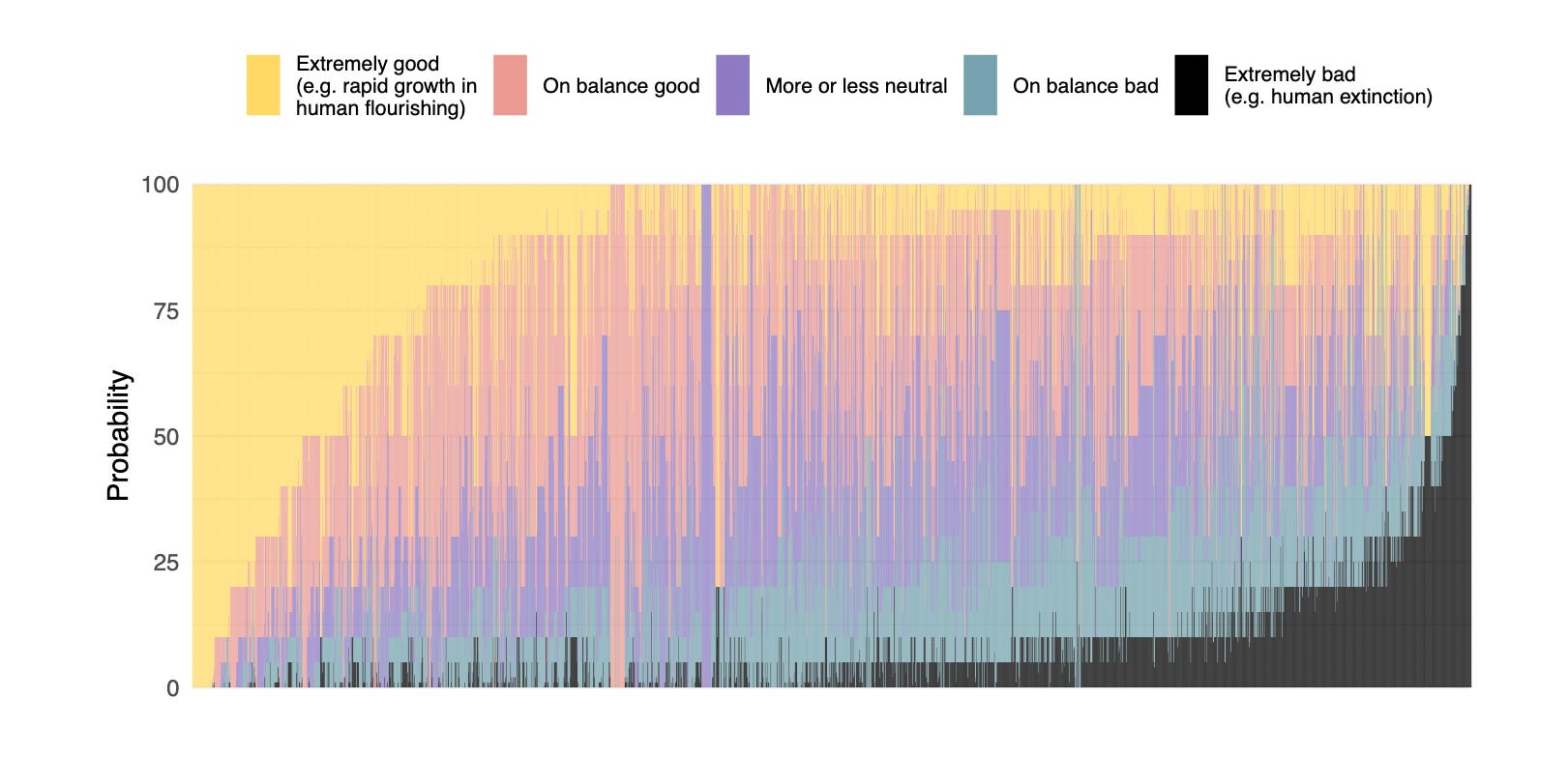
As you can see, most AI researchers put a serious chunk of probability on very different overall outcomes: maybe doom, maybe utopia. This is common. Most people I know who think there is a serious chance of the destruction of humanity from AI also believe that if humanity isn’t destroyed, things might be insanely good.
I often hear people talk as if this means we are in a trade-off where the question is whether the good outweighs the bad. For instance, they look at the people above who think there’s a 10% chance of extinction and a 30% chance of utopia and round this off to ‘net positive on AI’.
That seems like a kind of wild error. Like considering yourself optimistic regarding driving at 200mph to your new job if you think there’s only a 10% chance you’ll die in a fiery crash on the way there, and a 30% chance this job will radically improve your life.
The things you should be comparing are driving at 200mph and driving at a normal speed! The things you should be comparing are attempting to attain advanced AI by the current route, and by other routes!
We can debate whether all the other routes are bad or impossible somehow, for instance if constraining projects that risk loss of human control risks sending humanity into an irrecoverable ruin. But I don’t think having ruled out such things is why people are usually thinking in trade-off terms.
Rather I think this error comes from a few things:
It being simpler to think of ‘pros vs. cons’ and the topic being too abstract for people to intuitively notice that they are comparing pros of a long term outcome vs. cons of the first route there we have noticed
Sloppiness about talking about P(doom). Saying ‘P(doom)’ encourages thinking as if ‘AI’ implies a particular chance of ‘doom’. We should more accurately think about ‘p(doom|’such and such route’), e.g. P(doom|advanced AI from scaling up LLMs). People usually mean ‘P(doom|current trajectory)’ with some ambiguity about whether the current trajectory includes our own actions.
Thinking of AI as one scalar vs. a bunch of different things we could build
If you are bullish on some kind of advanced AI utopia, you should generally be less keen to try to achieve it via a careless route that leaves you at high risk of dying and losing it on the way there.
When I give a p(doom), it's very much influenced by predictions about how people will act (mainly leaders of AI companies). And that's not at all a simple extrapolation of current trends. I'm expecting some changes of trajectory in response to new evidence.
I don't see any route that looks equivalent to driving at a normal speed. Attempts at a pause increase the risk that ASI will be developed by an organization that's less responsible than currently leading AI companies.
So my position is somewhere in between the view you advocate here and the view you dismiss. I expect that unusually thoughtful policies might cut the risk in half. But we're likely still stuck with something resembling reckless driving.
> Thinking of AI as one scalar vs. a bunch of different things we could build
I feel like people are making this mistake about a *lot* of things. People asking "Should we do more or less of this thing?" instead of "How do we do this thing correctly instead of incorrectly?". I don't get it tbh.